Catalogue information
About this piece
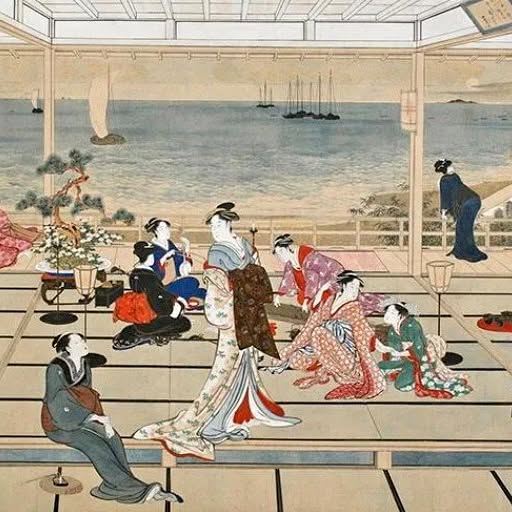
Framed w/ Glass 41 x 22 inches Utamaro (born 1753, Japan—died Oct. 31, 1806, Edo, Japan—d.) was a Japanese printmaker and painter who was one of the greatest artists of the ukiyo-e (“pictures of the floating world”) movement; he is known especially for his masterfully composed portraits of sensuous female beauties. Probably born in a provincial town, he went to Edo (now Tokyo) with his mother. There, under the name of Toyoaki, he started painting and designing rather unoriginal wood-block prints of women. He also occupied himself with nature studies and published many illustrated books, of which Gahon chūsen (1788; “Insects”) is best known. A mystery-man artist in 18th-century Japan created scenes of pleasure in the ukiyo-e genre. A century later, one of three unusually large scroll paintings in a triptych that was one of his masterworks disappeared. Then, more than a hundred years on, the missing work resurfaced. Art-world sleuths have no idea where the painting was during the intervening years. Kitagawa Utamaro (1753-1806), the mystery man, was considered one of the foremost practitioners of ukiyo-e, paintings that portray a “floating world” of pleasure. These works were particularly appealing to a rapidly industrializing West that was becoming obsessed with the East, a world seen as exotic and alluring. No matter that the graceful courtesans depicted with swooping necks, immaculate upswept hair, and beautifully draped kimonos were what we would call in contemporary parlance “sex workers.” At the time, the precision and harmony of these paintings’ style, as well as the romantic, glossy presentation of the subject matter, exerted a mighty pull on a Western world seeking escape from a period of often-frightening change.
Condition
Condition as described by seller